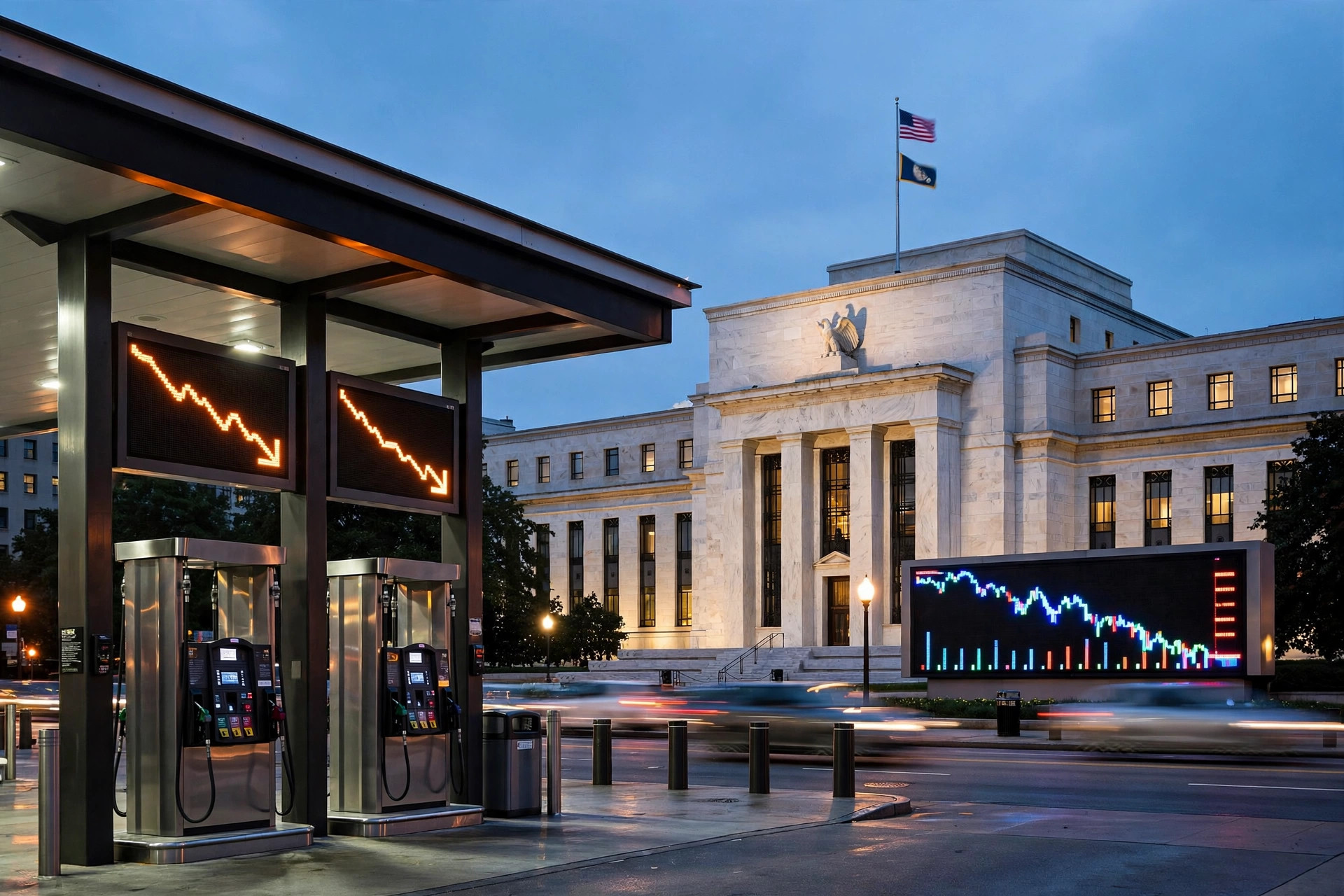
The Federal Reserve looks almost certain to raise interest rates in December, but a growing camp on Wall Street now believes that hike could be the last of the cycle. According to ING, rapidly falling energy prices are doing some of the central bank's work for it, cooling inflation just as policymakers prepare to tighten once more.
Fed December Hike Odds Near 95% After Hawkish Minutes
The minutes of the Fed's October 27-28 meeting, published on Wednesday 18 November, were strikingly direct. According to the minutes, almost all participants judged that a further increase in the target range in December would likely be appropriate, with inflation still well above the Fed's 2 percent goal. The committee had voted 10-2 to hold the federal funds rate at 3.75 percent to 4.00 percent in October, with Governor Lisa Cook and Cleveland Fed President Beth Hammack both favouring a quarter-point rise.
Markets have taken the message. According to CME Group's FedWatch gauge, traders now price a 95.7 percent chance of a 25-basis-point hike at the December 8-9 meeting, with only a 4.3 percent chance of a larger half-point move. Some measures put the chance of any hike at all at 100 percent.
Waller Pushes for 50 Basis Points as Williams Urges Caution
Not every policymaker agrees on the size of the move. Federal Reserve Governor Christopher Waller told CNBC on Wednesday that a 50-basis-point hike in December may be necessary unless policymakers clearly signal another increase in January. Waller pointed to three consecutive monthly core consumer price readings of 0.3 percent, a pace equivalent to roughly 3.5 percent inflation a year, and warned that too timid a step could weaken expectations that inflation will return to target.
New York Fed President John Williams struck a more cautious note, saying he does not believe the current situation calls for dramatic action. According to reports of his remarks, Williams ruled out a bigger move while maintaining that some monetary tightening is still necessary. The split leaves the December meeting as a genuine debate, even with a quarter-point rise now treated as near-certain.
Inflation Data Behind the Hawkish Turn
The case for tightening rests on stubborn price data. Headline consumer prices rose 0.4 percent month on month in October, against a 0.3 percent forecast, while core prices also rose 0.4 percent. Twelve-month PCE inflation reached 3.6 percent in September, with core PCE at 3.1 percent, and core retail sales climbed 0.6 percent, double the 0.3 percent forecast. Unemployment edged up to 4.2 percent in September, and the November Housing Market Index came in at 25, its lowest since April 2012.
ING: Falling Petrol Prices Could End the Hiking Cycle
James Knightley, chief international economist at ING, told CNBC TV18 that he expects a 25-basis-point rise in December, but believes the tightening cycle is likely to end there. The sharp decline in energy prices is one of the biggest reasons behind ING's outlook. According to Knightley, US petrol prices have fallen from about $4.50 a gallon to $3.75, while crude shipping costs have also dropped significantly.
"I think they will hike in December. I think that's pretty clear," Knightley said, adding that "after that, we're not looking for anything further" because energy prices are coming down aggressively. In his view, those falls should help dampen inflationary pressures next year, making further hikes unnecessary.
UBS takes a different view. In a note dated 16 November, its economists said they continue to expect 25-basis-point increases in both December and March, although the risk of consecutive hikes has grown. UBS pointed to US GDP growth of 3.4 percent in the third quarter and forecast S&P 500 earnings growth of 25 percent in 2026, arguing the economy can absorb a longer period of elevated rates.
What Happens Next for Markets
Stocks have already felt the strain. The S&P 500 fell 0.23 percent to 7,323.63 on Wednesday, its fifth straight loss, while the Dow Jones dropped 561.25 points, or 1.11 percent, to 50,198.17. The Nasdaq Composite managed a 0.42 percent gain to 24,429.88. The 10-year Treasury yield held around 5.07 percent, the dollar stayed near a 19-month high, and gold traded close to a 14-month low near $3,739.
The next big test comes on 25 November, when the October PCE price index is due. According to analysts, that report is the biggest potential turning point for the rate path: a soft reading would strengthen the case that December is the last hike, while another hot print could revive talk of a 50-basis-point move or further tightening in early 2027. The Fed's own survey of primary dealers found a median expectation of one hike in December and another in March 2027, followed by a cut in early 2028.
Related coverage on TradeMatrix
- Dollar Hits 19-Month High Near 104 as Fed Hike Bets Surge
- US Stock Futures Rise as Anthropic Record IPO Revives AI Trade
- Taiwan Stocks Plunge 3.7% as Asian Markets Slide on Fed Hike Fears
Tags: #FederalReserve #InterestRates #Inflation #Economy #StockMarket #Fed #USEconomy #Markets
Comments (0)