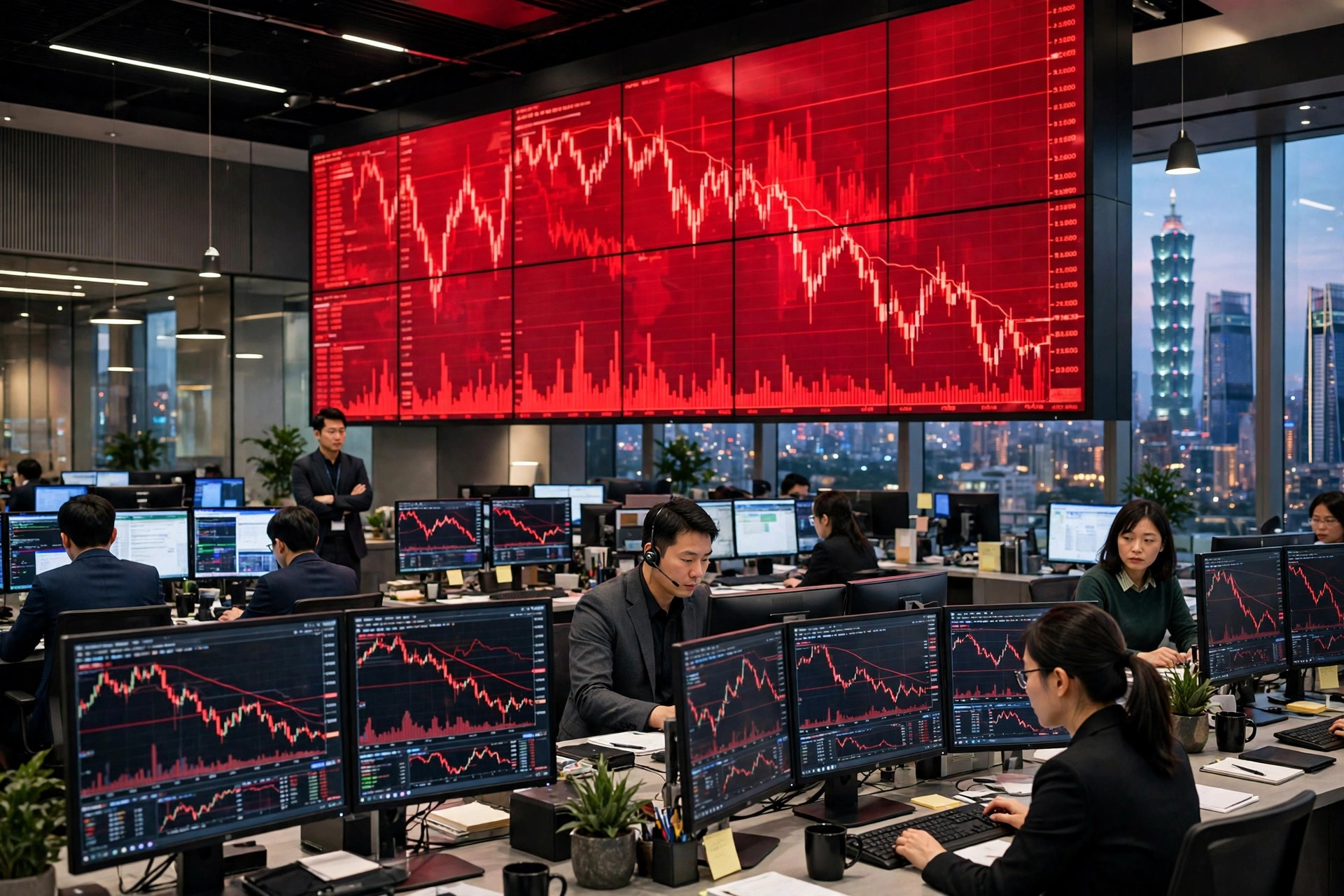
Asian markets fell broadly on Thursday, led by a sharp drop in Taiwan, as investors weighed hawkish signals from the US Federal Reserve and fresh wobbles in the artificial intelligence trade. Taiwan's Taiex led the declines, sliding 3.73%, while most regional benchmarks traded in the red during the early session.
Taiwan Leads Asia Lower as Chip Stocks Slide
Taiwan's benchmark Taiex dropped 3.73% to 38,697.09 in early trading on Thursday, according to market data reported by The Edge, with chip stocks at the centre of the sell-off. South Korea's Kospi fell 0.94% to 5,019.62, giving up early gains, while Hong Kong's Hang Seng index dropped around 2% to 22,829.
China's Shanghai Composite slipped 0.44% to 3,571.99, and Australia's S&P/ASX 200 declined about 1%. Seven of nine Asian indices tracked were lower in the early session. India was the exception to the gloom: the Sensex opened almost flat at 82,074.16, up 0.05%, while the Nifty 50 started at 25,186.80, down 0.16%, with GIFT Nifty futures pointing to a weak open.
Japan's Nikkei Holds Gains as Others Fall
Japan's Nikkei 225 was the notable outlier, rising 0.21% to 59,147.57 in early trading and extending gains later in the session, even as the broader Topix slipped 0.3%. The contrast underlines how uneven the region's reaction has been: markets most exposed to the AI chip trade fell hardest, while Japan's broader market found buyers.
The slide comes a day after South Korea's Kospi retook the 5,000 level on a rally sparked by Nvidia's earnings, showing how quickly sentiment has turned. Taiwan's market had also rallied earlier in the month when short-selling curbs calmed a regional rout, but Thursday's drop erased much of that comfort.
Fed Hike Fears Drive the Sell-Off
The main driver was monetary policy. Minutes from the Federal Reserve's October meeting, released on Wednesday, showed that almost all officials believed further rate hikes would be appropriate, reinforcing expectations of a December increase. Markets are now pricing roughly a 95% chance of a 25-basis-point hike at the Fed's December 8-9 meeting, according to CME FedWatch data reported this week, and Governor Christopher Waller has even floated a larger 50-basis-point move.
That hawkish tone pushed the US dollar index to around 103.8, close to a 19-month high, and kept the 10-year Treasury yield near 5.07%. Higher US rates and a stronger dollar typically weigh on Asian equities by raising borrowing costs and pulling capital back toward dollar assets.
AI Trade Wobbles After Nvidia's Slide
Chip stocks were also under pressure after Nvidia fell 2.9% on Wednesday despite reporting record quarterly revenue of $115.8 billion, more than double a year earlier. The shares erased an early post-earnings gain as investors focused on uncertainty following co-founder Jensen Huang's sudden departure last week, and the board's decision not to reinstate him as chief executive.
Not every chip name fell: AMD rose 5.31% and Broadcom gained 3.64% on Wednesday. But the AI trade that powered Asia's chip-heavy markets through much of the year is now facing its sternest test, with investors questioning whether spending on AI infrastructure can keep growing at the pace markets had priced in.
Anthropic Debut in Focus
Traders are also watching Anthropic's Nasdaq debut on Thursday after the AI company priced its shares at $83, raising about $81.3 billion in one of the largest offerings on record. The listing is seen as a key test of appetite for AI-linked companies, and its early trading could set the tone for chip stocks into the weekend.
Oil Steady, Gold Rebounds From 14-Month Low
Commodity markets offered some calm. Brent crude held near $92 a barrel and US benchmark WTI traded above $83, steady amid uncertainty over US-Iran tensions. Gold rebounded as much as 0.8% toward $3,755 an ounce on Thursday, recovering part of the previous session's losses after falling to a 14-month low, while silver gained 1.6% to $45.79 an ounce.
What Happens Next for Asian Markets
With the Fed's December meeting still three weeks away, Asian markets are likely to stay sensitive to every signal from US policymakers. Traders will watch US jobless claims later on Thursday, Anthropic's first day of trading, and the October PCE inflation reading due on November 25, which could decide whether the Fed moves by 25 or 50 basis points.
For now, the message from Thursday's session is clear: the combination of higher-for-longer US rates and doubts about the AI trade is hitting Asia's chip-heavy markets hardest, and Taiwan's 3.7% slide shows how fast the mood can turn.
Related coverage on TradeMatrix
- KOSPI Retakes 5,000 as Nvidia Earnings Spark Asian Chip Rally
- Wall Street Ends Mixed as Fed Minutes Lift Hike Bets
- Gold Hits 14-Month Low Near $3,742 as Fed Hike Bets Hammer Bullion
Tags: #AsianMarkets #TaiwanStocks #Taiex #KOSPI #Nikkei #FederalReserve #ChipStocks #StockMarket
Comments (0)