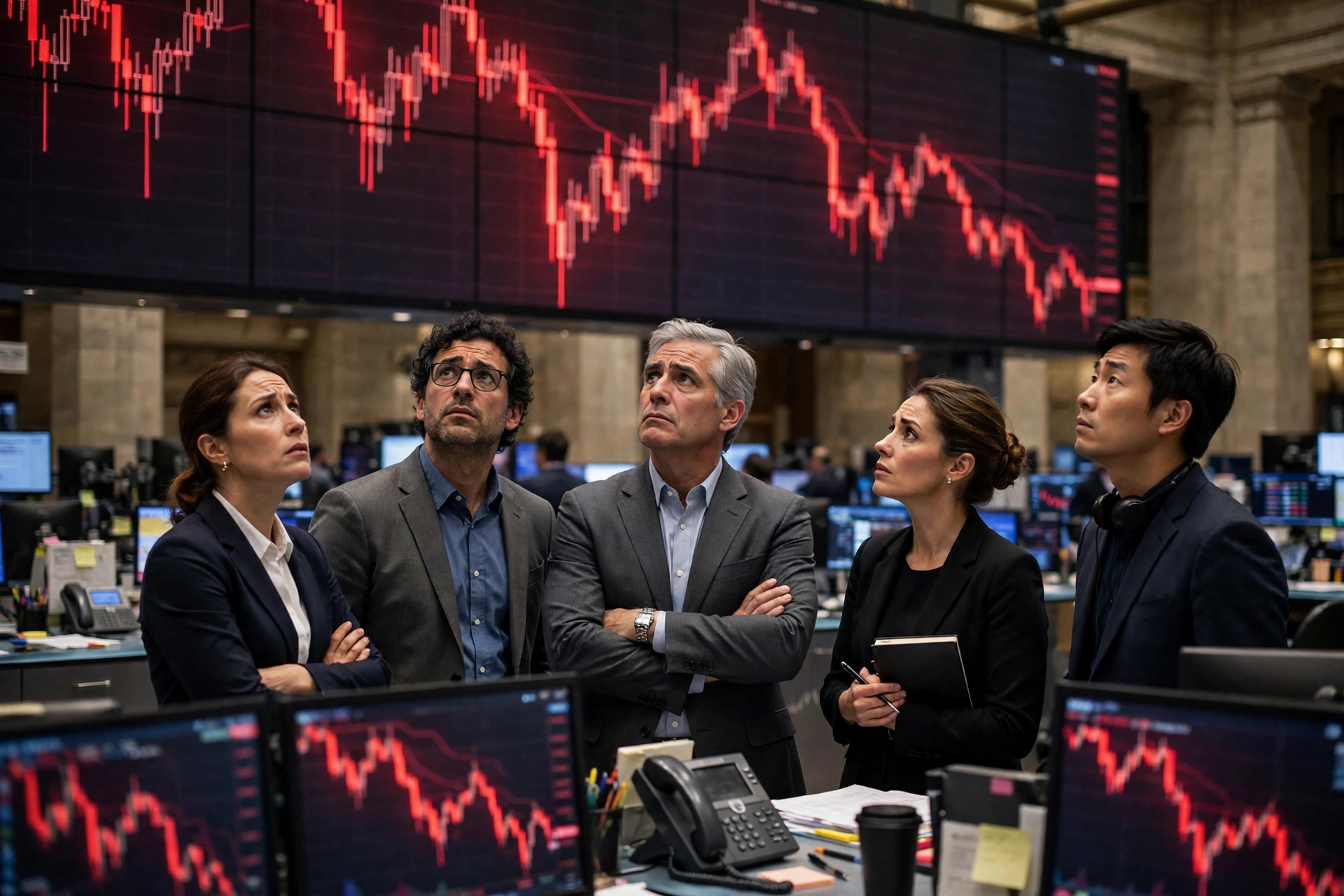
The S&P 500 is now just 1% away from wiping out every gain it made in 2026 — and, according to Bank of America, that level may be exactly what stops the Federal Reserve from raising interest rates again.
The benchmark index closed on Friday at 6,910.39, down 3.70% on the day and 8.6% for the week, leaving it only 65 points above the 6,845 mark that BofA chief investment strategist Michael Hartnett has identified as the line where the market's 2026 gains disappear entirely. Hartnett argued this week that the fastest way to stop the Fed from tightening further is for stocks to erase all of this year's gains — a threshold the market is now within a whisker of testing.
S&P 500 in Correction as Nasdaq Logs Worst Week Since 2020
Friday's slide capped a brutal week for Wall Street. The S&P 500 has now fallen for seven straight sessions, its longest daily losing streak since the onset of the coronavirus pandemic in 2020, according to Reuters, and sits 11.6% below its record high of 6 October. The index is in correction territory, and so is the Dow Jones Industrial Average, which fell 1.93% on Friday to 48,147.33 and lost 8% for the week.
The tech-heavy Nasdaq Composite fared worst of all, plunging 5.28% on Friday to 22,617.73 — a 10% weekly drop, its worst since March 2020 — and is now down 2.7% for 2026. The Cboe Volatility Index, Wall Street's fear gauge, jumped to 35.89 on Friday, its highest level in months, as investors rushed for protection.
Nvidia remained at the centre of the turmoil, falling 14% on Friday and 22.9% for the week after reports of a Securities and Exchange Commission accounting probe added to doubts about the sustainability of heavy artificial intelligence spending.
Fed Governors Signal More Hikes Are Coming
The sell-off has been driven as much by monetary policy as by technology valuations. Minutes from the Federal Reserve's 27–28 October meeting, released on Wednesday, showed that almost all policymakers expected another quarter-point rate increase in December, with some officials even discussing the possibility of a larger hike. The Fed held its benchmark rate near 3.9% in October after raising rates in September.
Fed Governor Lisa Cook warned on 20 November that the central bank urgently needs to raise rates to push inflation down, cautioning that delayed action could force even higher and faster increases later. Governor Christopher Waller has said he is open to a 50 basis point move in December, and traders now price a December hike as near-certain, with a standard quarter-point increase priced at around 97%, according to market data cited by Capital Street FX.
Why the 6,845 Level Matters
Hartnett's argument is that a market which has given back its entire year would force the Fed to pause: policymakers tightening into a market that has erased a year's gains risk deepening the downturn they are trying to manage. With the S&P 500 only around 1% above that level, the coming sessions could decide whether the Fed's December meeting on 8–9 December delivers another hike — or a pause forced by the market itself.
What Happens Next for Markets
Investors now face a short but dense week. Monday brings the first survey readings since the sell-off, with flash purchasing managers' indices for the euro area and the United States. Wednesday, 25 November, is the main event: October PCE inflation data and the second estimate of third-quarter GDP arrive at 13:30 GMT. A hot PCE reading would strengthen the case for a December hike; a soft one could give the market breathing room.
Thursday is Thanksgiving, with Wall Street closed, and Friday is Black Friday, when US stocks close early and liquidity will be thin. With the 10-year Treasury yield near 4.91% and the dollar index at its strongest since April 2025, few corners of the market have offered shelter. As Nationwide chief market strategist Mark Hackett told Reuters, the sell-off has reset valuations to more attractive levels and pushed sentiment gauges to levels that have often historically signalled buying opportunities — but with negative momentum still building, few investors are willing to call the bottom yet.
Related coverage on TradeMatrix
- S&P 500 Valuation Alarm: CAPE Above 40 Echoes Dot-Com Bubble
- S&P 500 Heads for Worst Week Since April as Sell-Off Deepens
- Thanksgiving Week Markets: PCE, GDP and Fed Beige Book in Focus
Tags: #SP500 #StockMarket #FederalReserve #InterestRates #Nasdaq #WallStreet #BofA #Investing
Comments (0)