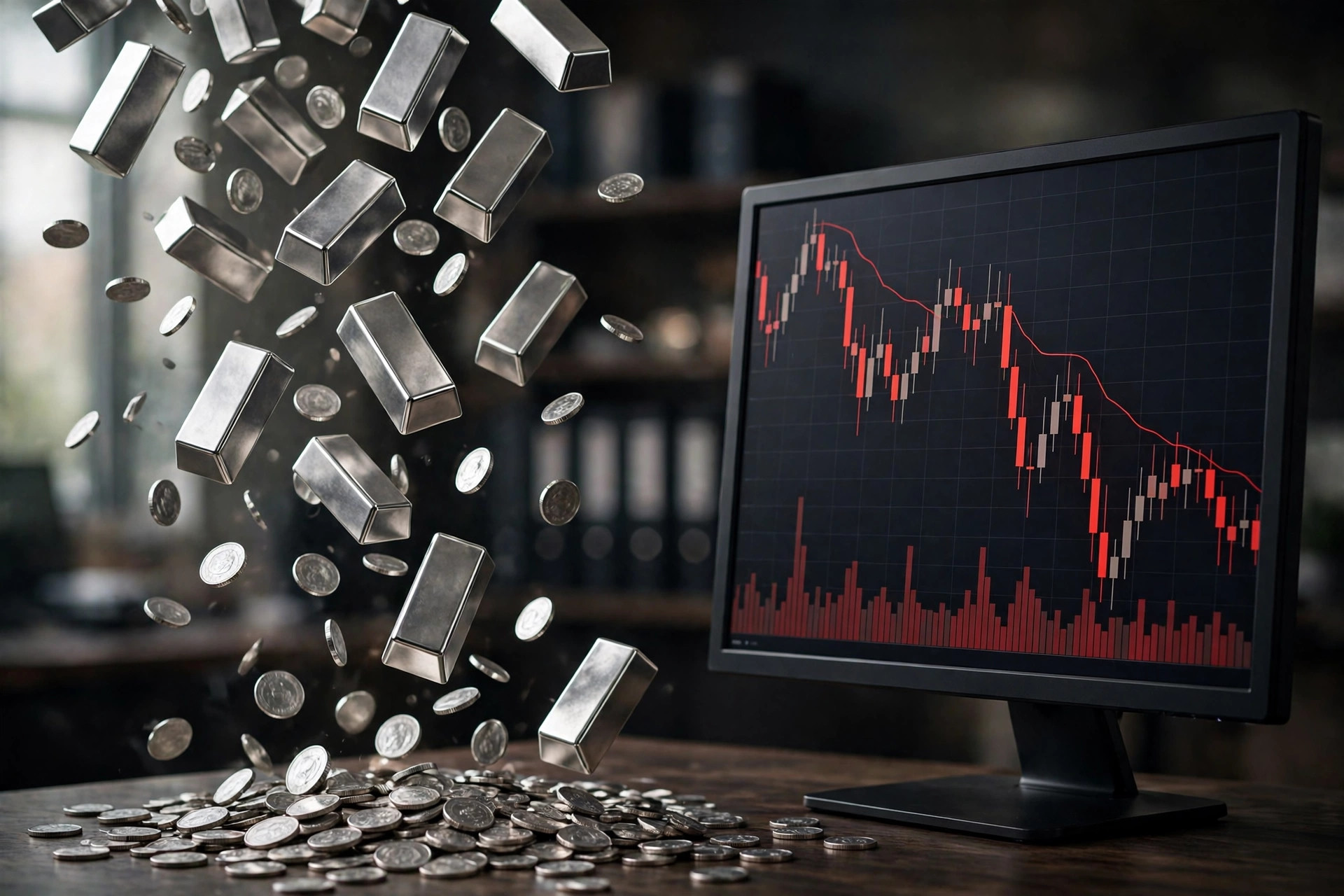
Silver has crashed below $45 an ounce, extending one of the most brutal corrections in the metal's modern history and leaving it down roughly 63% from its January peak. The white metal, which traded above $121 an ounce at the start of the year, is now at its lowest level since September 2025 — and analysts warn the selling may not be over yet.
Spot silver fell about 5.3% on Wednesday to $44.88 an ounce, according to News18, while silver futures settled near $45.06. Reuters data quoted by several outlets put spot silver at around $45.38 on Thursday morning, still below the psychologically important $45 level for much of the session. Gold, its larger cousin, has fared better but is hardly unscathed: spot gold traded near $3,737 an ounce, down about 33% from its January record of $5,594.82.
Silver price collapse: 63% below the January peak
The scale of the silver price collapse is hard to overstate. Silver surged to a record $121.64 an ounce in January 2026, more than 2.4 times its previous nominal highs of around $49.50 set in 1980 and 2011. It has now given back almost two-thirds of that peak. According to analysis cited by Moneycontrol, silver would need a 170% rally just to return to its January high, while gold would need roughly 50% to reclaim its record.
The gold-to-silver ratio — the number of ounces of silver needed to buy one ounce of gold — has climbed to around 83, its highest level since November 2025, underscoring how much harder silver has been hit than gold. Research firm Ned Davis Research noted that silver has fallen more than 20% from its all-time high on only four other occasions in the past 58 years.
Why silver is falling: Fed hike bets and a 19-month dollar high
The immediate trigger is a sharp shift in US monetary policy expectations. Markets are now pricing in a Federal Reserve rate hike at the December meeting, with CME FedWatch odds of a quarter-point move at around 89–92%, following hot October inflation data and hawkish minutes from the Fed's October meeting, released in the early hours of Thursday. The minutes confirmed that almost all officials saw further hikes as likely, and governor Christopher Waller has even floated a 50-basis-point move.
At the same time, the US dollar index has climbed to a 19-month high near 104, while the US 10-year Treasury yield sits around 5.05–5.15%. A stronger dollar makes dollar-priced metals more expensive for overseas buyers, and higher yields raise the opportunity cost of holding non-yielding assets such as silver and gold.
ETF outflows and fading demand add to the pressure
Silver's decline is not only about rates and the dollar. According to the Silver Institute's November update, total silver demand is forecast to fall by 5% in 2026, with industrial demand down 3%. Holdings in silver-focused exchange-traded funds stood at 1.25 billion ounces in early November, down 4% from the start of January, and Metals Focus expects a further outflow of 45 million ounces by the end of the year. Analysts at ActionForex noted that silver has now lost more than 21% over the past month, far worse than gold's 9.5% drop, as speculative buying has dried up.
What happens next for silver and gold
Views on the outlook are split. Economist Peter Schiff argued that precious metals are likely to hold up better than other assets over the long term and will outlast the next inflation shock. Others are more cautious: ActionForex said that as long as ETF outflows and the slump in speculative demand continue, pressure on silver will persist, adding that a return of gold above $4,000 and silver above $55 would be needed to invalidate the bearish scenario. Some analysts see gold testing $3,600 and then $3,500, with silver possibly slipping to $42–$40 an ounce.
Both metals look oversold, with relative strength readings near 23, so a relief bounce is possible. But with the Fed's December decision still three weeks away and the dollar at a 19-month high, traders are watching Friday's US jobless claims and the Philadelphia Fed survey for any sign that the rate-hike case is softening. Until then, silver's fall from $121 to $45 stands as one of the sharpest reversals in commodity market history.
Related coverage on TradeMatrix
- Gold Hits 14-Month Low Near $3,742 as Fed Hike Bets Hammer Bullion
- Copper Plunges 5.3% in Worst Day in Over a Year as AI Bets Unravel
- Gold Slips Below $4,000 as Oil and Fed Hike Fears Bite
Tags: #Silver #SilverPrice #PreciousMetals #Gold #Commodities #FedRateHike #USDollar #Markets
Comments (0)