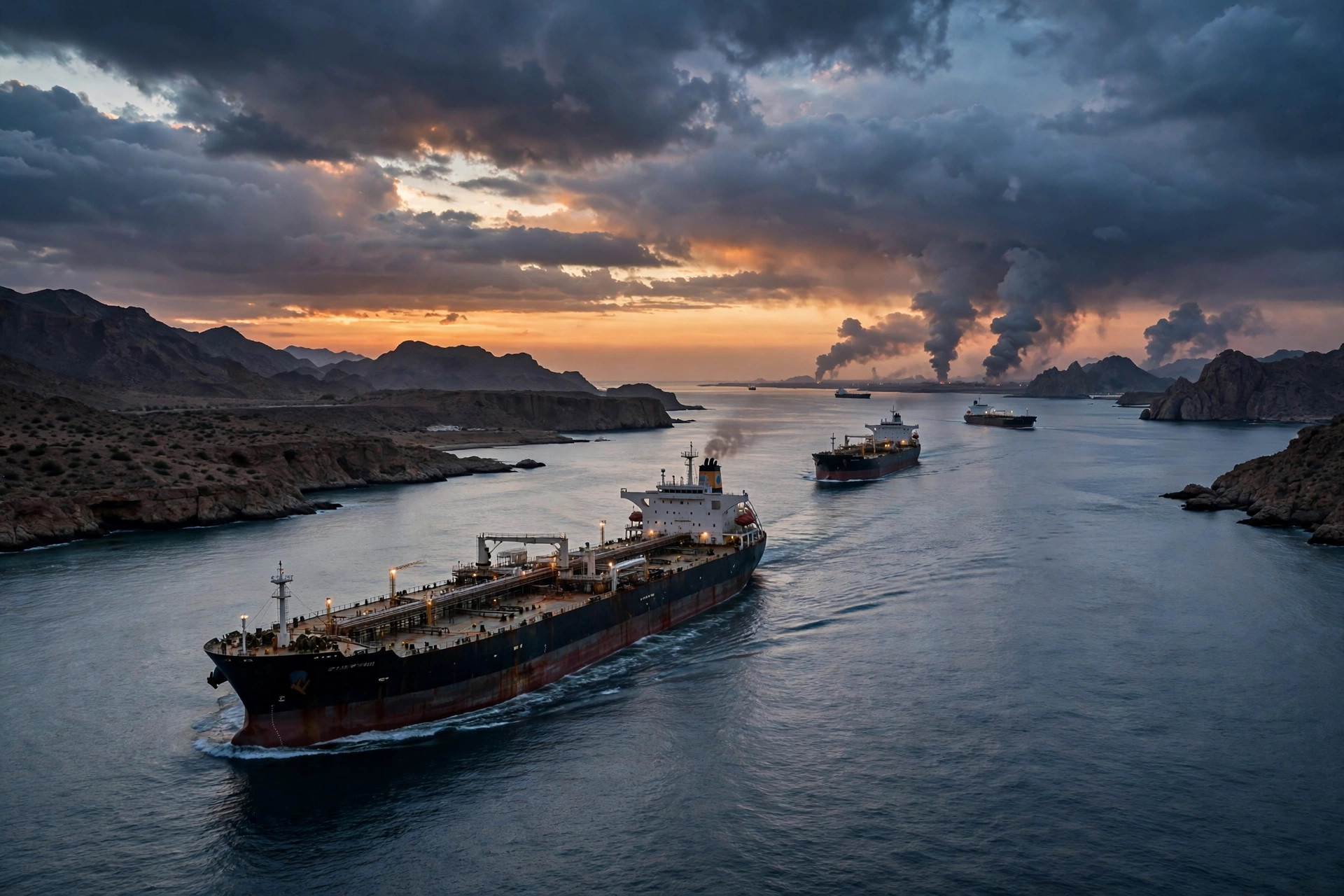
Two oil tankers were attacked in the Strait of Hormuz on Saturday, in the latest escalation around the world's most important oil shipping chokepoint — yet Brent crude barely moved. The market's calm response underlines how a growing global supply surplus is, for now, outweighing the risk of war in the Gulf.
Two tankers hit in the Strait of Hormuz on Saturday
The United Kingdom Maritime Trade Operations (UKMTO) reported that one tanker was struck by an unknown projectile while sailing out of the strategic waterway, sustaining damage to its stern, with no casualties reported. In a separate incident, another tanker was struck in its engine room, according to reports carried by Daijiworld.
Iran's army said separately that an oil tanker had caught fire after striking a naval mine in the Strait of Hormuz, after entering a restricted zone east of the strait. Iran's Islamic Revolutionary Guard Corps (IRGC) Navy said tankers have been striking mines in the strait on a daily basis this month, and reported on Thursday that two tankers hit naval mines and were burning. The claims have not been independently verified.
Qatar has sent a delegation to Tehran in a fresh diplomatic effort to mediate the ongoing conflict between Iran and the United States, which began in late February with US-Israeli strikes on Iran.
Brent crude holds near $92 despite the attacks
Brent crude futures settled at $92.57 a barrel on Friday, down 3.4% on the week for a third consecutive weekly decline, while US benchmark West Texas Intermediate (WTI) finished at $83.98 a barrel. Oil prices did rise late on Friday as traders weighed the risk of fresh attacks and bought crude ahead of the US Thanksgiving holiday, but the weekly trend remained firmly lower.
The muted reaction is striking given the scale of the disruption. The Strait of Hormuz handled approximately one-fifth of global oil supplies before the war, and shipping data analysed by the Financial Times showed oil tanker transits through the strait had fallen from 52 to 37 in the week ending 18 November.
Houthi strikes reach Riyadh as Gulf tensions widen
The tanker attacks came in a week in which the confrontation widened. Houthi missiles struck targets in Riyadh on Thursday, including the city's financial district and the headquarters of the country's sovereign wealth fund. The Houthis had earlier said they fired five drones at two pumping stations on Saudi Arabia's East-West pipeline. According to the International Energy Agency, the Gulf has lost 2.8 billion barrels of oil and 60 billion cubic metres of gas in supply since the war began.
Why oil is trading on money, not missiles
Analysts say the market is trading on supply, not on the attacks. The IEA forecasts that worldwide oil demand will fall by 2.7 million barrels a day during 2026, and expects supply to exceed demand in the fourth quarter of this year, with a potentially larger surplus in 2027.
That surplus is the reason Brent has now fallen for three weeks running even as tankers burn in the strait. The costs of the disruption are showing up in freight and product prices rather than in the headline crude price — for now.
What happens next for oil prices
Traders will watch the OPEC+ meeting on 29 November and whether the tanker attacks escalate into a strike on a loading terminal or processing plant — something that has not happened so far. Any hit on Gulf export infrastructure, rather than on ships in transit, would test the market's calm in a very different way. Until then, the pattern of recent weeks looks set to hold: attacks on symbols and ships, and a crude market that keeps drifting lower on the weight of surplus supply.
Related coverage on TradeMatrix
- Oil Slides Below $92 as Supply Surplus Fears Outweigh Iran Tensions
- Brent Posts Biggest Weekly Drop Since 2022 as Tanker Attacks Hit
- Dollar Retreats as Oil Dives 4% on Iran Deal Hopes
Tags: #Oil #BrentCrude #StraitOfHormuz #EnergyMarkets #Geopolitics #OPEC #OilPrices #MiddleEast
Comments (0)