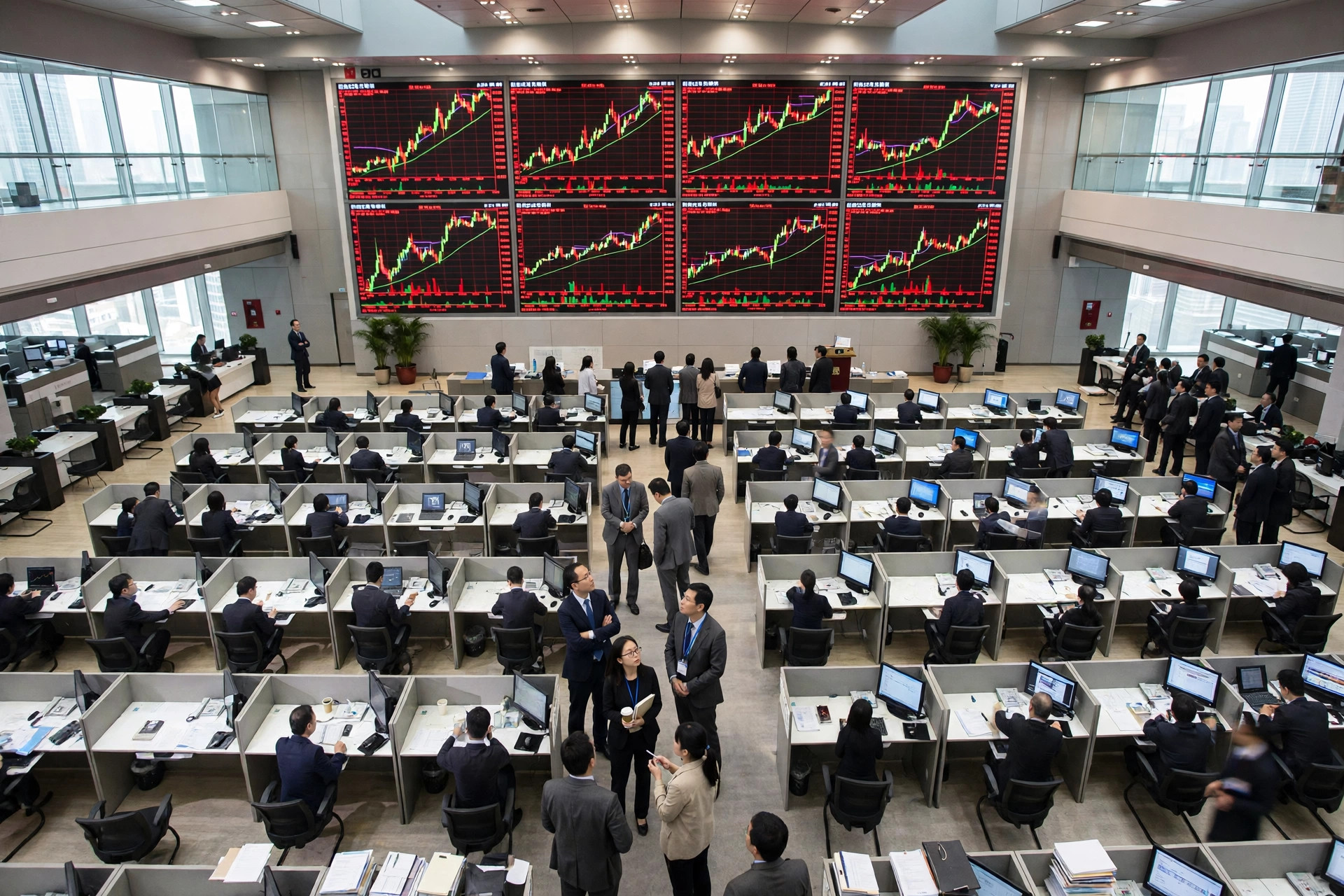
China's state-backed funds poured a record 90 billion yuan ($13.5 billion) into exchange-traded funds on Friday, in the most forceful attempt yet to halt a months-long sell-off that has pushed the benchmark CSI 300 Index into a bear market.
Inflows into the nine ETFs known to be actively traded by the so-called national team topped the previous record of 87 billion yuan, set during the market rout of April 2025 triggered by US tariffs, according to data compiled by Bloomberg. Over the weekend, Beijing added a second lever: a cut in margin-financing rules designed to free up more money for share purchases.
Record buying tops the April peak
The buying was concentrated in the market's largest funds. The Harvest CSI 300 ETF drew a record 23 billion yuan, while the ChinaAMC SSE 50 ETF attracted an all-time high of 21.7 billion yuan, Bloomberg's data show.
According to reports in the Chinese press, the national team has been stepping up purchases of the biggest ETFs since October, as a sell-off led by artificial intelligence stocks deepened. The CSI 300 has now fallen in all but two weeks since August, and the intervention comes after months in which the benchmark drifted steadily lower.
Buying has yet to put in a floor
For all the scale of Friday's buying, the market has not yet found a bottom. The onshore benchmark fell as much as 1.3% on Monday, and market breadth remains weak: the share of stocks trading above their 200-day moving averages slumped on Friday to just 8% in Shenzhen and 12% in Shanghai, the lowest since just before Beijing's sweeping stimulus package in September 2024.
Analysts quoted in the reports noted that much of the national team's buying has come late in the trading session, supporting headline indices such as the CSI 300 while providing little lift to the broader market.
Margin rules eased to 80% from 30 November
On Sunday, China's three main stock exchanges announced that the minimum margin-financing requirement for investors buying securities with borrowed funds will fall to 80% from 100%, effective 30 November. The change, approved by the China Securities Regulatory Commission, reverses a tightening introduced in January.
By letting investors buy more shares with the same amount of their own capital, the move is expected to create roughly 400 billion yuan in additional buying capacity, according to estimates carried by Chinese media. The Shanghai and Shenzhen exchanges also announced plans to waive or reduce some trading fees, while the Shenzhen exchange proposed a market-making mechanism for its ChiNext startup board to curb share-price swings.
Authorities have also cut the cost of loans used to finance corporate share buybacks, lowering the re-lending rate to 1.0% from 1.25% and making the programme permanent, and have supplied liquidity to financial institutions to support further stock purchases.
Leveraged buyers are pulling back
The easing comes as leveraged investors retreat. The outstanding balance of margin trades fell 1.9% on Friday, its steepest decline since 20 July, according to the reports. Outstanding margin loans have dropped by more than 20% since the end of June, from about 3 trillion yuan to around 2.2 trillion yuan.
Taiwan moved in parallel on Monday, tightening restrictions on short selling — raising the minimum margin requirement for short sales to 150% from 130% — and stepping up share purchases through a government fund worth 500 billion Taiwan dollars.
What happens next
Traders will watch whether the record ETF inflows and the margin easing can finally stabilise the CSI 300 when the new margin rules take effect on 30 November. The test will be breadth rather than the headline index: until more than a small fraction of stocks trade above their long-term averages, the rescue risks looking like support for the benchmark rather than a recovery for the wider market.
The global backdrop is no help. The sell-off in AI shares that began on Wall Street last week has spread across Asia, and Beijing's measures arrive alongside stabilisation efforts in South Korea and Taiwan. For now, the national team's record buying has bought time — but not yet a floor.
Related coverage on TradeMatrix
- Sensex Drops 1,100 Points as Nifty Slips Below 25,500 in Global Rout
- VIX Fear Gauge Hits 2026 High as Goldman Panic Index Reaches 9
- Bitcoin Rebounds to $62,000 as Citi Cuts 12-Month Price Forecast
Tags: #China #StockMarket #ETFs #CSI300 #AsiaMarkets #Beijing #MarginTrading #Investing
Comments (0)